Bridging sales execution gaps: From strategy to results
September 19, 2025
AI SALES
ARTIFICIAL INTELLIGENCE
Bridging sales execution gaps starts with recognising the fundamental disconnect between what sales teams plan to do and what actually happens in the field. Every revenue organisation faces this challenge. You create brilliant strategies, design perfect processes, and train your team extensively.
Yet when it comes to live customer interactions, something gets lost in translation.
This gap between intention and action costs businesses millions in lost revenue, extended sales cycles, and missed opportunities. Using an AI sales execution platform will connect strategic planning with practical results that bridge these caps.
What are sales execution gaps?

Sales execution gaps represent the measurable difference between planned sales activities and actual performance outcomes. These gaps manifest when your carefully crafted sales strategies fail to translate into consistent, repeatable success in the field.
The most common execution gaps include:
- Knowledge gaps: Reps lack immediate access to critical product information during customer conversations.
- Process gaps: Teams skip essential steps or inconsistently follow established methodologies.
- Communication gaps: Important context gets lost between prospect touchpoints or team handoffs.
- Technology gaps: Sales tools don’t integrate properly or require too much manual work.
- Coaching gaps: Feedback and improvement happen too slowly or infrequently to impact real performance.
Why sales execution gaps happen
Sales execution gaps occur because traditional sales environments create natural friction points that interrupt the flow from strategy to action.
The primary culprit is information fragmentation—critical data lives scattered across multiple systems, making it nearly impossible for reps to access everything they need in the moment.
Most sales organisations also struggle with the timing of support. Training happens in classrooms, coaching occurs in post-call debriefs, and strategy updates come through quarterly meetings. But selling happens in real-time conversations where immediate support would make the biggest difference.
The result is improvisation instead of execution, leading to inconsistent outcomes across the team.
The cost of sales execution gaps
Revenue teams pay a steep price for execution gaps, with research showing that 77% of buyers won’t engage with salespeople who lack insight into their business. This disconnect directly impacts win rates and deal velocity.
Poor product knowledge alone can extend sales cycles by up to 40%, while administrative friction consumes 64% of a sales rep’s time—time that should be spent actually selling. When you multiply these inefficiencies across an entire sales organisation, the cumulative effect is substantial.
The hidden costs run even deeper:
- Lost competitive advantages when reps can’t articulate value propositions clearly
- Decreased team morale as reps struggle with tools that slow them down rather than speed them up
- Inconsistent customer experiences that damage brand reputation and reduce referral rates
- Missed upselling opportunities because reps lack real-time prompts about additional products or services
- Poor forecast accuracy when pipeline data doesn’t reflect actual conversation outcomes
Companies that fail to address execution gaps often find themselves stuck in a cycle of hiring more reps rather than making existing reps more effective. This approach multiplies the problem rather than solving it.
How to bridge sales execution gaps

Bridging sales execution gaps requires a systematic approach that addresses both process and technology challenges. The most effective strategies focus on reducing friction at every stage of the sales cycle rather than adding more complexity – something AI sales execution systems excel in.
Fix preparation before calls start
Most reps waste valuable time researching prospects manually or enter calls with generic talking points that don’t resonate.
Smart preparation systems automatically pull together client-specific intelligence, recent company news, and relevant case studies into digestible briefings. This approach ensures every conversation starts with relevant insights rather than generic pitches.
Support reps during live conversations
Traditional sales tools fail reps during live conversations when they have to switch systems, search documents, or rely on memory. These can damage your rep’s rapport and credibility.
AI sales assistants can understand meeting context and surfaces relevant information to reps without interrupting the flow. This includes instant access to pricing, competitive responses, and cross-sell opportunities based on what’s actually being discussed.
Handle follow-up work automatically
The biggest execution breakdown happens after meetings when critical details get forgotten, next steps remain unclear, and follow-ups get delayed. Manual note-taking and CRM updates consume hours while important momentum dies.
Automated follow-up systems transform conversation recordings into structured CRM updates, generate personalised follow-up emails, and create clear action items.
Learn what works and repeat it
Most sales teams operate blindly, unable to identify which strategies work and which create execution gaps. Without systematic analysis of what drives success, teams repeat ineffective approaches indefinitely.
Learning systems create continuous improvement loops by analysing conversation patterns, identifying successful tactics, and surfacing these insights to replicate winning approaches across the team.
If you’re ready to see how systematic gap prevention works in practice, booking a demo with Captivatte Salespilot can show you exactly how AI fills the space between sales strategy and execution.
Role of AI in closing sales execution gaps
Artificial intelligence transforms sales execution by providing real-time support that adapts to each unique selling situation. Unlike static training materials or rigid processes, AI can deliver personalised guidance that evolves with every conversation.
The Before, During, After Framework
Modern AI platforms like Captivate approach execution gaps through comprehensive support.
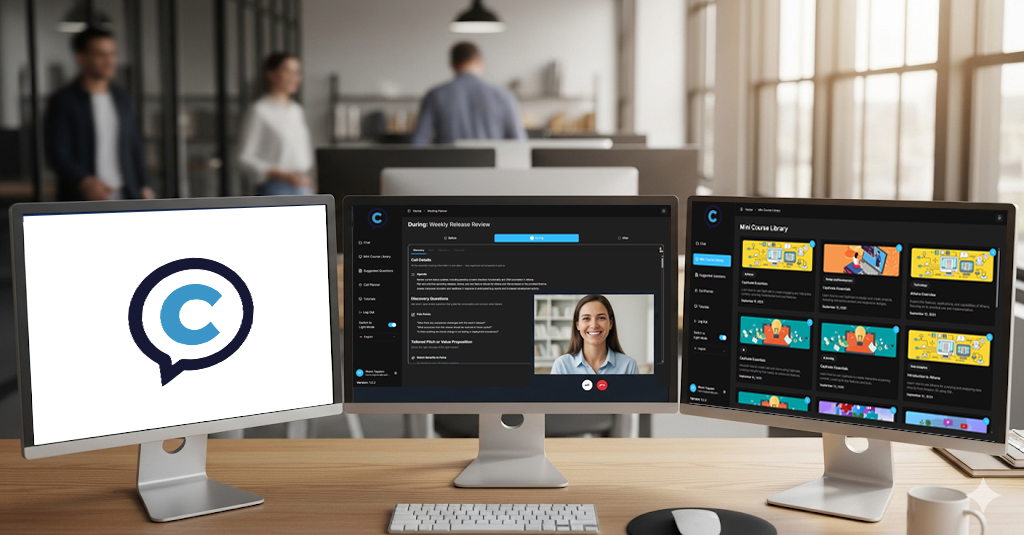
Salespilot, our AI sales execution platform, does this with three main modules:
- Before Module: Automated research, client insights, and targeted mini-courses fill knowledge gaps
- During Module: Live prompts, product information, and cross-sell suggestions eliminate hesitation
- After Module: Automated CRM updates and follow-up scheduling prevent administrative gaps
This framework addresses execution gaps at their source by ensuring consistent support regardless of rep experience level or call complexity.
Network intelligence for competitive advantage
Individual sales teams struggle with execution gaps because they operate in isolation, unable to benchmark performance or spot emerging trends that could improve their approach.
Captivate’s revenue intelligence layer aggregates anonymised data across organisations to provide market intelligence no single company could generate alone. This network effect gives teams access to benchmarks, trends, and early warning signals that improve execution across the board.
Future of sales execution: Strategy + AI alignment
The future of sales execution lies in the seamless integration of human strategy with AI-powered support systems. Rather than replacing salespeople, AI will eliminate the friction points that prevent good strategies from becoming great results.
We’re moving toward a model where every sales interaction is supported by real-time intelligence. AI will handle the mechanical aspects of selling—data retrieval, note-taking, follow-up scheduling—while humans focus on relationship building and strategic thinking.
Orchestrated intelligence
The next evolution involves AI orchestration platforms that coordinate multiple specialised agents across the entire revenue organisation. Rather than managing separate tools for different sales tasks, these platforms create integrated ecosystems where everything works together.
The Captivate Platform exemplifies this approach by connecting AI agents, data sources, and human workflows into a unified system. This coordination ensures that when strategies change, the entire system adapts automatically—no manual updates or retraining required.
Predictive execution
Future AI systems will predict execution gaps before they occur, automatically adjusting support and resources to prevent problems rather than fixing them after the fact. This proactive approach will make sales execution as reliable and predictable as other business operations.
The organisations that bridge execution gaps first will gain sustainable competitive advantages that become harder to replicate as their AI systems learn and improve from each interaction.
Let’s bring your sales execution to the future
Ready to bridge your sales execution gaps? Book a demo to see how Captivate’s AI-powered approach can transform your sales strategy into consistent results.
Do you want to expand your sales knowledge? Here is our guide about AI sales outreach.
Making the switch to AI-powered sales execution
Early adopters are already seeing measurable results. According to the Salesforce State of Sales study, high-performing sales teams are 4.3 times more likely to use AI than their underperforming counterparts.
Teams embracing AI sales agents aren’t just working faster—they’re working smarter. They’re building stronger relationships because they’re always prepared, closing more deals because they never miss buying signals, and scaling success because best practices automatically become team-wide standards.
At Captivate, we’ve built our AI sales assistant around this philosophy, creating AI agents that work before, during, and after every sales interaction to amplify human potential rather than replace it.
Traditional sales coaching focuses on developing individual skills. AI Sales Coach systems take this further by providing real-time guidance and continuous improvement loops that benefit the entire team.
Ready to see how AI agents can transform your sales execution? Book a demo and experience the difference between AI tools that watch your sales process and AI agents that actively improve it.
Curious about the inner workings of sales? Check out our guides.
Frequently Asked Questions
Common questions about this topic
What are sales execution gaps?
Sales execution gaps are the measurable differences between planned sales strategies and actual performance outcomes. These gaps typically manifest as knowledge shortfalls, process breakdowns, or technology friction that prevents reps from executing at their full potential.
How can companies bridge sales execution gaps?
Companies can bridge sales execution gaps through a combination of providing real-time access to information, implementing just-in-time training, automating administrative tasks, and creating systems that support natural selling behaviours. Modern AI solutions like Captivate have proven particularly effective because they provide personalised, contextual support throughout the entire sales cycle, eliminating friction points that create execution gaps.
Can AI help close sales execution gaps?
Yes, AI significantly helps close sales execution gaps by providing real-time support that adapts to each selling situation. AI can prepare automated call briefings, deliver instant access to product information during conversations, provide live coaching prompts, and handle post-meeting administrative tasks.