AI agents in sales assistance (how they're transforming the way reps sell)
August 28, 2025
AI SALES
ARTIFICIAL INTELLIGENCE
AI agents in sales assistance are transforming how sales teams close deals, but most reps don’t realise they’re already working alongside primitive versions of these intelligent systems. Your top rep just closed a massive deal, but when you ask how they handled that tricky pricing objection, they shrug and say “I just went with my gut.” Meanwhile, your newest hire is struggling with the same objection and has no idea what “going with your gut” even means.
This is where AI sales agents change everything. Instead of hoping your team’s best practices somehow transfer through osmosis, these smart AI assistants capture, learn from, and instantly share winning strategies across your entire sales organisation.
But AI-driven sales assistants aren’t just another sales tool promising to revolutionise your execution process. They’re autonomous systems that actively participate in your selling, making real-time decisions that directly impact deal outcomes.
What are AI sales assistants?

Think of an AI sales agent as your most experienced sales rep, but one that never forgets a detail, never has an off day, and can be in every conversation simultaneously.
AI sales assistantsare intelligent systems that work alongside your reps throughout the entire sales cycle. Unlike traditional automation that follows rigid if-then rules, these agents:
- Understand context and recognise conversation patterns
- Make autonomous decisions based on real-time situations
- Adapt their responses to each unique prospect interaction
- Learn from successful outcomes and replicate winning strategies
Here’s what sets them apart: they don’t just track what happened—they actively influence what happens next. When a prospect mentions budget constraints, an AI agent doesn’t just log that information. It instantly surfaces relevant ROI calculators, pulls up case studies from similar companies, and suggests specific talking points that have worked in comparable situations.
How AI agents differ from traditional automation
Most sales automation tools are like sophisticated alarm clocks—they do exactly what you tell them to do, when you tell them to do it. AI sales agents are more like experienced sales managers who can think on their feet.
Traditional automation:
- Follows predetermined sequences regardless of context
- Sends Email A on day one, Email B on day three
- Continues churning along even when prospects respond unexpectedly
- Requires manual intervention when situations change
AI-driven sales assistants:
- Analyse prospect responses and understand sentiment
- Adjust approach based on buying signals and engagement levels
- Accelerate or modify sequences based on real-time behavior
- Make intelligent decisions without human intervention
The key difference is intelligence versus instruction. Automation follows instructions. AI agents make intelligent decisions.
Benefits of using AI sales assistants

The impact of AI agents in sales assistance goes far beyond simple efficiency gains:
- Speed: Process information and trigger actions in milliseconds. While a human rep might take minutes to find the right case study, an agent delivers it instantly—eliminating awkward “I’ll get back to you” moments.
- Accuracy: Never forget product details, pricing structures, or customer history. Every conversation is backed by accurate, up-to-date information without human memory lapses.
- Personalisation at scale: Replicate the best reps’ ability to read between the lines across hundreds of conversations simultaneously, analysing communication patterns and adjusting messaging to match each prospect’s style.
- Complete call visibility: Most sales directors struggle with limited visibility on what’s really happening in calls. Captivate’s Salespilot, an AI-driven sales assistant and revenue intelligence platform, records, transcribes and analyses every meeting. Directors get real-time reporting on what was said, how reps handled objections, and conversation dynamics. This creates a clear, data-driven view of performance rather than relying on patchy CRM notes.
According to Forrester research, personalised content can lead to a 20% increase in sales opportunities. When AI agents handle personalisation heavy lifting, reps focus on human connections that close deals.
Real-world examples of AI agents in action
Here’s how AI-driven sales assistants work across the sales cycle, thanks to Captivate’s Salespilot:
Before the call:
- Reviews prospect’s recent website visits, email engagement, and social media activity
- Creates personalised briefing documents with relevant talking points
- Identifies potential objections based on similar prospect profiles
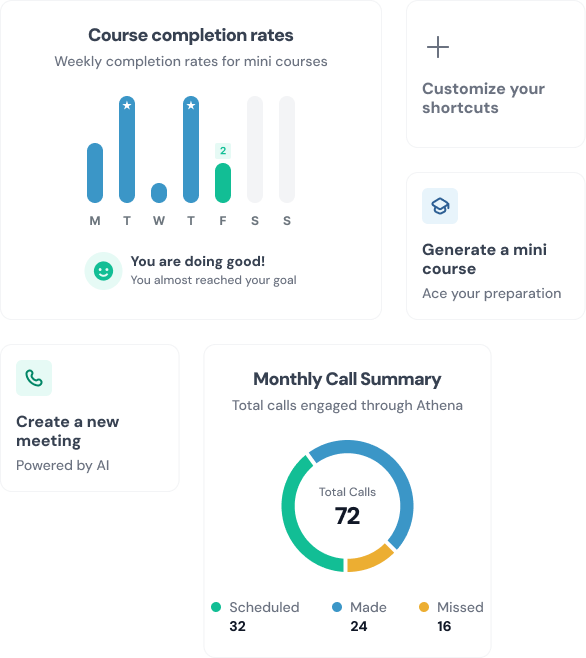
- Generates on-demand micro-courses for skill gaps identified from previous interactions
During the conversation:
- Listens in real-time for buying signals, objections, and questions
- Instantly provides technical documentation when prospects ask about integrations
- Offers competitive positioning when competitors are mentioned
- Delivers live prompts and coaching suggestions without disrupting conversation flow
After the call:
- Analyses conversation for next steps and action items
- Automatically updates CRM with relevant conversation details
- Triggers personalised follow-up sequences based on specific commitments
- Generates performance insights for coaching opportunities
One of the biggest challenges for sales teams is that training is expensive and hard to apply at the moment. Instead of relying on costly, one-off training sessions, Salespilot by Captivate generates on-demand micro-courses before calls and provides live prompts during them. Reps learn in context, at the exact moment they need it—making training continuous, cheaper, and more effective.
A Gartner study found that B2B buyers spend only 17% of their time actually meeting with potential suppliers during their purchase journey. AI agents maximise the value of these limited interactions by ensuring every moment is productive and relevant.
Unified intelligence: Breaking down data silos
Most sales directors struggle with insights fragmented across CRM, enablement tools, and conversational intelligence systems. Salespilot by Captivate acts as middleware, integrating with existing CRM, chat, and AI systems. It pulls everything into one flow—briefings, call analysis, and admin automation—so directors get a single source of truth rather than chasing information across multiple systems.
This unified approach addresses a critical gap: no existing tool provides an end-to-end “before, during, after” solution. Captivate’s SalesPilot is designed specifically to span the whole sales cycle. It prepares reps before calls, guides them during conversations, and closes the loop after with automated follow-up. Directors no longer need separate tools for enablement, call analysis, and CRM updates—it’s all in one AI-driven workflow.
Market intelligence that transforms strategy
The anonymised data layer from Salespilot gives sales directors benefits at both the rep and organisational level that traditional AI agents can’t provide:
- Market-wide intelligence: Aggregated win/loss benchmarks, average deal cycles, and emerging objection trends across the entire network. No single company’s CRM can deliver this scope of competitive intelligence that maximises revenue.
- Early warning systems: Real-time trend signals surface weeks before they hit the wider market—spikes in budget freezes, new competitor mentions, or emerging buyer concerns like AI compliance. Directors can course-correct faster than competitors operating without this visibility.
- Data-driven coaching: Insights into what behaviors correlate with higher win rates, including talk-listen ratios, questioning cadence, and effective follow-up timing. Training becomes evidence-based instead of guesswork, helping directors focus coaching efforts where they’ll have the most impact.
- Content optimisation: Data reveals which sales collateral, scripts, or demo formats are converting best across industries. Directors can standardise approaches around what actually works, rather than what they think works.
This creates a compounding advantage: competitors inside the network get market shift visibility sooner, while those outside operate blind. The more companies join, the more valuable the intelligence becomes.
The future of sales with AI agents
We’re still in the early stages of what AI agents can accomplish. The next wave will bring even more sophisticated capabilities: agents that can negotiate pricing within predefined parameters, conduct preliminary discovery calls for straightforward use cases, and manage complex multi-stakeholder buying processes.
But the core principle remains constant: AI agents handle predictable, routine aspects of selling so human reps can focus on strategic, creative, and relationship-building activities that actually close deals.
The question isn’t whether AI agents will transform sales—it’s whether your team will lead that transformation or get left behind.
Making the switch to AI-powered sales assistance
Early adopters are already seeing measurable results. According to the Salesforce State of Sales study, high-performing sales teams are 4.3 times more likely to use AI than their underperforming counterparts.
Teams embracing AI sales agents aren’t just working faster—they’re working smarter. They’re building stronger relationships because they’re always prepared, closing more deals because they never miss buying signals, and scaling success because best practices automatically become team-wide standards.
At Captivate, we’ve built our AI sales assistant around this philosophy. Its work before, during, and after every sales interaction is designed to amplify human potential rather than replace it.
Traditional sales coaching focuses on developing individual skills. AI Sales Coach systems take this further by providing real-time guidance and continuous improvement loops that benefit the entire team.
Ready to see how AI agents can transform your sales performance? Book a demo and experience the difference between AI tools that watch your sales process and AI agents that actively improve it.
Do you want to expand your sales knowledge? Here is our guide about the BANT sales methodology.
Frequently Asked Questions
Common questions about this topic
What is an AI sales assistant?
An AI sales assistant is an intelligent system that actively participates in your sales process, making autonomous decisions and taking actions in real-time. Unlike traditional automation that follows predetermined rules, these agents adapt to unique situations, learn from successful patterns, and provide contextual support throughout the entire sales cycle.
How do AI agents improve sales performance?
AI agents improve performance by providing instant access to relevant information during calls, generating contextual training content, and automating administrative tasks. They analyse conversations in real-time to identify coaching opportunities and surface market intelligence that helps teams adapt to emerging trends and buyer behaviors without relying on fragmented data sources.
Are AI agents replacing sales reps?
No, AI agents are designed to augment human sales reps, not replace them. They handle data processing, routine tasks, and information retrieval so reps can focus on activities that require human judgment: relationship building, creative problem-solving, and navigating complex emotional dynamics. The human element remains essential for trust-building and strategic thinking.